Search the Synapse

Friday, March 4, 2011

3D Audio Craziness!

Well, in light of the dearth of posts, I must admit things have been pretty crazy for me lately. Certainly crazy in more ways than one, but here is kind of craziness you want to hear about, I promise!

Professor Edgar Chouieri, professor of Mechanical Engineering at Princeton, gave dinner discussion last Friday, Feb. 25, titled "3D Audio" as part of an art and science lecture series organized by the newly formed student group, Music in Mind. Here was the event description:
Lecture and Dinner brought to you by the Music in Mind (MiM) group:

An excerpt:
I’m about to hear a demonstration of Choueiri’s Pure Stereo filter, which promises “truly 3-D reproduction of a recorded soundfield.” Only a handful of people have heard his 3-D demo, but it’s already spawned awestruck hype, as well as preemptive rumblings of audiophile skepticism. -- Atlantic Monthly, March 2011.

So sure, that sounds pretty cool, but the lecture was way more than just cool! We actually got to hear 3D audio (if you're befuddled as to what 3D audio even means, bear with me for a while, or read the above article). Professor Chouieri brought in a small black rectangular device--one of those things that you might mistake for a pencil box--that played out sound in 3D. When I held black box (Chouieri's, not Tolman's) an arm's length away from my head, I heard bird sounds not only to the left and right of me (what regular speakers can do), but I could also hear a bird as if it were right next to my right ear, and another one just a little farther away, or another one a little behind me. I could hear actual depth in audio, and it was wonderfully uncanny. It was quite entertaining to see the looks of awe on everyone's faces (all 50 of us!) as the device was passed around the room.

You're wondering, how does this work? Well, the answer is surprisingly obvious--in the same way that 3D images work. (We witness here again how creativity and innovation arise from applying old concepts in new ways.) We see 3D images by eliminating cross-talk between the eyes. In the same way, we hear 3D sound by eliminating cross-talk between the ears. I'm being horribly vague, so please check out this video! It does a much better job at explaining this extremely fascinating stuff:


Professor Chouieri's going to California in a few weeks to talk with the movie makers. Imagine having 3D audio in the movie theatres, and then 3D audio TV, 3D audio CDs...! Professor Chouieri offered to show us his 3D Audio and Applied Acoustics Lab; we're working on organizing groups to visit for Music in Mind and perhaps even working with him on the creation of a 3D audio musical project. Crazy awesome!

Wednesday, January 26, 2011

A Hyper-Emotion Theory of Psychological Illness

An article appeared in the New York Times this month titled "Giving Alzheimer’s Patients Their Way, Even Chocolate." It's a feel-good article about giving in to the whims of patients to improve their mood, encouraging music and painting and flower arranging in an emotion-focused atmosphere, proving significantly effective in treating disease. 
The article attests to the importance of considering the impact of emotion in treating psychological disorders, and it got me thinking about the hyper-emotion theory of psychological illness (A Hyper-Emotion Theory of Psychological Illness), a theory by Phil Johnson-Laird, Francesco Mancini, and Amelia Gangemi, postulating that psychological illness is not a result of faulty reasoning (as is the main tenet of cognitive therapy and Aaron Beck), but one of hyper-emotion, or inappropriately intense emotional reactions. In fact, the research finds that those with psychological illness are better at reasoning when the reasoning is related to their illness. Johnson-Laird describes the theory in his book, How We Reason:
[Cognitive therapists] stress that a closer questioning of patients yields thoughts revealing that the source of illnesses is in faulty inferences. But, according to the present theory, the patients' remarks do not elucidate the cause of the hyper-intensity of their emotions, but merely their thoughts about the precipitating object or situation yielding the emotion. Their reasoning is not the cause of their illness, but its consequence. Indeed, those of us with a propensity to mental illness reason better than control participants, though only on matter concerning the illness. (p.100)
The hyper-emotion theory certainly revolutionizes the way we think about cognitive therapy. Instead of treating how we think, should we be treating how we emotionally respond? And how would we go about doing so? Perhaps, as Johnson-Laird mentions in his book, through exposure therapy, which falls under the domain of behavioral therapy. So should cognitive therapy really be a form of behavioral therapy? Then again, cognitive therapy has strong research support (as does behavioral therapy), so how does the hyper-emotion theory address that? 
Just as an artistically synaptic side-note, Phil Johnson-Laird also does research on the psychology of music (see his music-related work here), which includes emotions and music, creativity and jazz improvisation, dissonance, twentieth-century music, computer music, and rhythm (we are currently working on a study of rhythm similarity).

Saturday, December 18, 2010

Sinfonia Concert: A Review

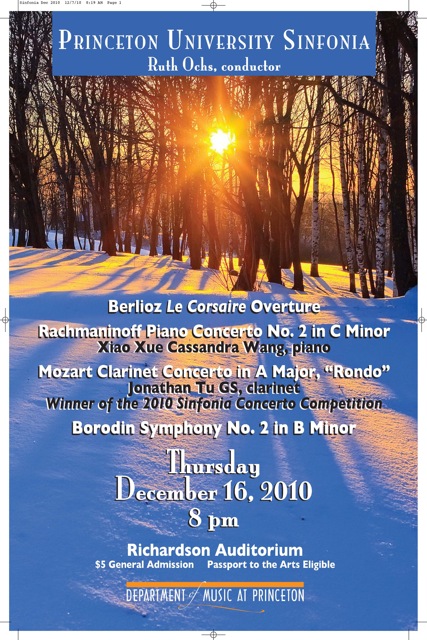
The Princeton University Sinfonia gave a fun-spirited concert on December 16 at Richardson Auditorium, with Ruth Ochs as conductor. The program consisted of  Berlioz’s Le Corsair Overture, Rachmaninoff’s Piano Concerto No. 2 (Cassandra Wang, piano), Rondo from Mozart’s Clarinet Concerto in A Major (Jonathan Tu, clarinet), and Borodin’s Symphony No. 2.

Berlioz’s Le Corsair Overture served as a riveting, bombastic opening to the concert, with Berlioz’s typical “come to the greatest show on earth” feel. Berlioz wrote the original version of this overture in August 1844 at Nice and led its first performance in Paris on January 19, 1845, then called La Tour de Nice (The Tower of Nice). Although the orchestra started off a little shaky, with entrances that could have been more confident, things eventually came together as the melody unfolded in the first section. Finally, the booms of the tympani resonating throughout the hall and the blaring brass served as a grandiose end to the beginning of a lively concert.

From such bombastic show of display, we are brought into another type of display: subtle virtuosity in Rachmaninoff’s famous Piano Concerto No. 2, composed in 1900-1901 and premiered with Rachmaninov himself as the soloist on November 9, 1901, in Moscow. I emphasize “subtle” virtuosity despite the obvious technical difficulty of the piece as a compliment to Cassandra Wang, the pianist. Cassandra glides through the runs with seeming effortlessness, and makes the most difficult of passages seem easy. Her playing reminds me of that of Yefin Bronfman’s, with a stoic body concealing the most expressive sounds. Her tone is warm and lyrical, taking the listener sighing into a far away dreamscape, especially in the beautiful adagio sostenuto. Cassandra deserves special commendation for her discerning ability to stay with the orchestra. The orchestra took the piece overall much slower than it is normally played, especially in Mvt. I and III, yet Xiao was able to restrain herself from the urge to rush (although noticeable) extremely well and patiently.  Although being greatly under tempo, and intonation issues in soloists (oboe), Cassandra’s solid and expressive performance made this piece the highlight of the concert.

Leaving behind the brilliant Romanticism of Rachmaninoff and the piano, we are transported to the wonderfully Classical world of Mozart and the clarinet in the Rondo from Mozart’s Clarinet Concerto in A Major. Mozart famous and only concerto for clarinet, known for its delicate interplay between orchestra and soloist, was written in 1791 for the clarinetist Anton Stadler. The clarinetist of the Sinfonia concert was Jonathan Tu, a graduate student at Princeton University and winner of the 2010 Sinfonia Concerto Competition. Despite a beautiful and warm tone, Jonathon had some trouble with his embouchure and excess air was often heard as he played. Nevertheless, the piece was quite enjoyable, maybe even a little too pleasant. In a way, the Mozart sounded a little too “perfect,” too “nice.” What was lacking in this performance, in both the orchestra and the soloist, was the feel of Mozartian whimsicality and playfulness. The dynamics were a little flat, and more contrasts would have made the experience more “fun,” in the playful Mozart style.

Finally, the concert ended with the heroic Borodin Symphony No. 2. The symphony was composed intermittently between 1869 and 1876, and is considered the most important large-scale work completed by the composer himself. Again, unconfident entrances took away from the boldness of the piece, especially in the opening sectional entrances of the Allegro theme. However, as the piece progressed, some really nice sounds started to come together. The double-tonguing of the brass in the Scherzo was effective in creating a underlying current of arousal, the vibratos of the strings created a wonderfully evanescent sound effect in the Andante, and the strong brassy sound at the end Finale served as a bold conclusion of finality. Sinfonia performed a concert of many popular delights in a more casual atmosphere. Though not a world-class orchestra, or the PUO, Sinfonia transports us to various places of musical adventure in a less intense manner.

Sunday, November 21, 2010

Music and Mental Illness: Buttonwood by Greg Spears

Tonight, the JACK Quartet gave a stunning world-premiere performance of Buttonwood by Greg Spears at the Crane Arts center in Philadelphia. It was a piece of beauty musically, conceptually, and contextually. Beauty undefined in all its abstraction.

Contextually, the piece reflects Greg’s experience as an artist-in-residence at the Buttonwood Psychiatric Hospital in the winter of 2010. During intermission, I talked with Dr. Schimmel and other hospital workers, who described Greg’s interaction with and dedication to the patients as going beyond anything expected. He would attend 3 hour meetings with hospital workers and patients, and trudge through coldness and snow to get there. He not only composed and performed for patients, but played with them. According to Dr. Schimmel, Buttonwood “captures the treatment team’s enthusiasm and narrative through various disciplines…the cacophony, feelings, and moods of the patients.” Conceptually, Greg describes the piece as portraying the “sense of external normalcy versus the intense drone of internal struggle” in the narratives of the patients. It is a beautiful concept—of leaving an imprint of such an experience for the composer, the patients, and the world, each able to take away what each will, with the hope that music can better the understanding of psychiatric illness.

Musically, the piece is one of profound beauty (if you’re willing to take my word for it). There is beauty in deviation. The violin reaches out in fragments of desperate abrupt crescendos against the drone of the cello. We feel the intense internal struggle of individual patients, of the desperate attempt to break the entrapment of illness (the violin’s cries) grounded by a sense of external continuity found in the hospital (the cello’s drone). Even in seeming normalcy, elements of deviation are detected by the listening ear. For example, there are times when two violins play the same melody the same time, but one is “normal,” the other is “dirty”, with scratches and screechings, signaling that while in life appears to continue in all its external regularity, inside things are on the verge of breaking apart. The piece begins and ends with a sense of peace and calmness, surprising given the context of psychiatric struggle and cacophony. Yet, beneath the calmness is a quiet loneliness, found in the quiet high-pitched cry of a violin. We leave with this sense of quiet loneliness steeped in an understanding of intense internal struggle—deep, profound, and beautiful.  

Yet, perhaps even more touching, even more beautiful than the conception, performance, or composition was the reception of the piece. Person after person after person came to talk to Greg after the performance (received with standing ovation), and to hear the words of gratitude from those from the hospital, to see the smiles on their faces and the appreciative warmth in their eyes, speaks to impact of Buttonwood in capturing the "quiet drama" of mental illness that could not be expressed, or only too often misunderstood.  Buttonwood is a testament to hidden struggle of the mentally ill, and a testament to the power of music to express where words fail.