Search the Synapse

Showing posts with label Classical music. Show all posts

Saturday, December 1, 2018

The "Fantastique" fantasies of Hector Berlioz


I come reeling tonight from a performance of Berlioz's Symphonie Fantastique, performed by the Columbia University Medical Center Symphony Orchestra, through which, I had the wonderful opportunity to reignite a dormant love of playing clarinet (not played since high school!). I thought I'd share, below, the program notes I was invited to write for the program, which, as it happens in the spirit of this Synapse, suitably has its own art-science (music-medicine) link!

Wednesday, August 24, 2011

Why do we cry when something is beautiful?

Because it is too beautiful, too beautiful to last.
--Michael Tilson Thomas on Mahler Symphony No. 1, Mvt III, at 5:20-7:00 below (Bernstein conducting):


Thursday, May 19, 2011

A Night of Sublime Thunder: The Tokyo String Quartet


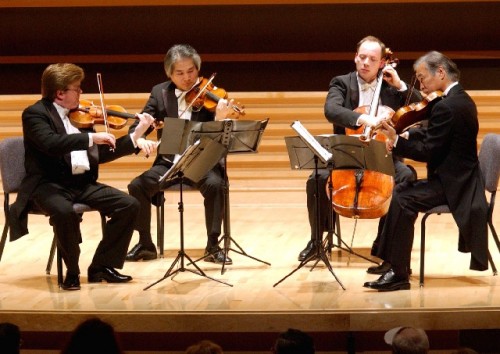
The last concert of the Princeton University Concerts 2010-2011 season  featured the renowned  Tokyo String Quartet. The program consisted Mozart Quartet No. 15 in D Minor, Takemitsu String Quartet No. 1 "A Way A Lone," and Beethoven Quartet in B-flat Major, Op. 130.

The program itself is a stormy one. Melanchoically sublime. According to the program notes, the pieces are tied together by "influence," all of the pieces being greatly influenced by previous composers (Mozart by Haydn, Takemitsu by post-Romanticists, and Beethoven by Handel). It is interesting to note that all of these pieces were later works from each composer's life. What's more interesting is that these later works are all some of the most tumultuous pieces of each composer, and I think it is this character that defines this concert and ties together the pieces, more so than the influence. For instance, the Mozart Quartet No. 15 is the only quartet that Mozart had written in a minor key (D minor--interesting, the same key as the only minor piano concerto Mozart had written, Piano Concerto No. 20). And as for the Beethoven, excluding the infamous "Great Fugue," Op. 133 (the last piece Beethoven had written--horribly painful as Beethoven's testament to the destruction of music), the Op. 130 is one of the greatest, and most unpredictably contrasting Beethoven string quartet. Now for the Takemitsu, I am unfamiliar with his work, but Quartet No. 1 was also composed later in this contemporary composer's life (1981), and was literally (or shall I say, musically) governed by the word, "SEA" (Eb (S corresponding to German pitch designation, E, and A). In this case, the SEA was tempestuous indeed. I thought the program selection in itself already set apart this concert from others. It was definitely one of the most "emotional" concerts I've attended, one reason being because all the pieces were so profound. I treasure concerts for that emotional experience, and I certainly got it here (just maybe a bit much though).

Now many sublime and thunderous things happened in each piece, but there was one eerie external and internal instance of it that I must share. Some sublime thunder happened during the Cavatina of the Beethoven. Literally and figuratively.  This movement is the definition of sublime. So much beauty and sorrow. It is said that Beethoven wept when he heard this in his head. This piece was actually sent to the heavens (okay, space--it was sent on the Voyager mission into space). What is truly uncanny is that during this movement (shortly after the heartwrenching "Beklemmt" passage, in which the first violin is "choked up" in anguished free recitative) a rumble of thunder resonated throughout the concert hall (there was a storm outside). It was as if the Gods were responding to such human suffering and sorrow; as if Beethoven had firmly said from the sky, "and let it be no more." But alas, it continues. Thank goodness it does. What would be a world with no suffering? A world without happiness?

Of course, the Tokyo String Quartet was phenomenal. I'd like to give a special shout out to the violist and cellist. In the rarer moments when I felt like things were getting rushed, the violist played with the "pauses" (but not pauses, just the inclination of a pause...) needed. I thought the violist played with the most conviction, mainly because he really played the silences. And the cellist, my goodness that deep, rich, sound gives me the chills just thinking about it! I've always been partial to cellos, but what I heard from this cello really resonated through my body and warmed it.

After the concert at the reception, I was very lucky to have gotten a chance to talk to one of the quartet members, Kikuei Ikeda (violin) and to express how much I enjoyed their performance. He was really pleased and asked me if I played any instruments, to which I replied that I was minoring in piano performance. His next response was completely unexpected and humble. He told me how exceptionally talented he thought us undergraduate musicians were (more so than graduate students), how he thought it was amazing how we were so intelligent and dedicated to our academic studies and yet exceptional musicians as well, referencing his experience teaching undergrad musicians at Yale.  Well, those words awakened me like the thunder did. I was really speechless, for I would have never imagined, this world-renowned musician felt humbled by us! It's really amazing how fast perspectives can shift, how fast relationships can change; how stepping outside of your own shoes for a while makes the world a different place. Music does that in so many ways, direct (like the concert), and indirect (like the reception), and turns an otherwise normal night into one of sublime thunder.

Monday, March 14, 2011

Boston Symphony Orchestra: Haydn, Bartok, and Beethoven

Chronicles of Boston Breakout: An Introduction
This begins the chronicles of "Boston Breakout: Music, Mind, and Medicine," a week-long spring break trip sponsored by the Princeton University Pace Center for Civic Engagement focused on learning about music therapy, music and medicine research, and volunteering to improve the community and lives of at-risk youth through the arts. After many months of busy planning, I'm so happy the trip is happening and going so well! I'll share here some snippets of the exciting things our group of eight students, ranging from English to Molecular Biology to Philosophy majors all with a deep love of music, are doing outside what we students call "the orange bubble."

Day 1: Boston Symphony Orchestra


On Saturday, we went to the renowned Boston Symphony Orchestra for a delightful concert of Haydn, Bartok, and Beethoven. The program featured Haydn's Symphony No. 93 in D, Bartok's Piano Concerto No. 3, and Beethoven's Symphony No. 5, conducted by Roberto Abbado, with Peter Serkin as pianist (both substitutions for James Levine and Maurizio Pollini, who were were both unfortunately ill). See the concert program and program notes here.

The concert was, of course, splendid. It was a wonderful blend of witty Classicism (Haydn), intricate Romanticism and virtuosity (Bartok), and finale classic (Beethoven 5). And, no less than expected, the Boston Symphony performed with classic ingenuity.

Which was my favorite piece? Well...I might give in and let the popular classic shine in it's glory for once. I must say the Allegro finale of Beethoven 5 left quite an impression on me. The sonority and shear power of the brass's entrance before the upward scalar run of the strings sent those wonderful chills through me. Bravo brass! That movement was my highlight of the concert. However, I thought Movement 1, Allegro con brio, with the famous fate theme (ba ba ba buuummm...) was a little too hurried for my taste, despite the nature of the movement. I would have liked to hear more silence, more 'breaths" between some phrases.

So I think I'll have to reconsider. I mean, the Haydn was really delightful, in the witty delight that Haydn is! And really, as a pianist myself, how could I not consider the Bartok? Peter Serkin played with technical brilliance and showmanship. However, as a critical pianist, I think his touch was a bit harsh, especially during the Adagio religioso (his wrists seemed high, and his shoulders and arms seemed somewhat stiff in general).

Though I may not have quite made up my mind on which piece was my favorite, I can certainly say this will be a concert that I will treasure forever! It's such an returning to the wonderful Boston Symphony Hall, and to share the experience with such a wonderful group of friends. It was a shame that James Levine was ill, but Roberto Abbado did a masterful job in his place.

Saturday, December 18, 2010

Sinfonia Concert: A Review

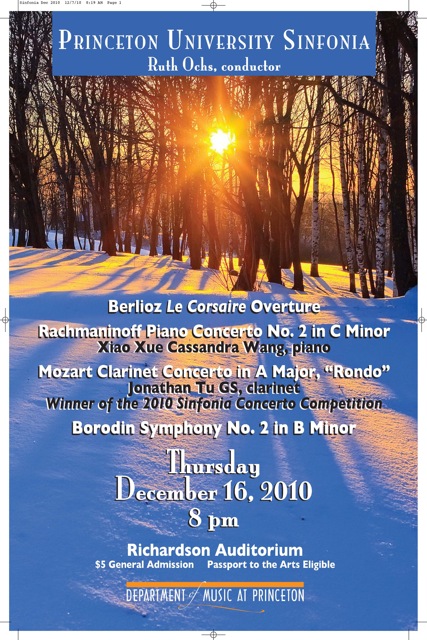
The Princeton University Sinfonia gave a fun-spirited concert on December 16 at Richardson Auditorium, with Ruth Ochs as conductor. The program consisted of  Berlioz’s Le Corsair Overture, Rachmaninoff’s Piano Concerto No. 2 (Cassandra Wang, piano), Rondo from Mozart’s Clarinet Concerto in A Major (Jonathan Tu, clarinet), and Borodin’s Symphony No. 2.

Berlioz’s Le Corsair Overture served as a riveting, bombastic opening to the concert, with Berlioz’s typical “come to the greatest show on earth” feel. Berlioz wrote the original version of this overture in August 1844 at Nice and led its first performance in Paris on January 19, 1845, then called La Tour de Nice (The Tower of Nice). Although the orchestra started off a little shaky, with entrances that could have been more confident, things eventually came together as the melody unfolded in the first section. Finally, the booms of the tympani resonating throughout the hall and the blaring brass served as a grandiose end to the beginning of a lively concert.

From such bombastic show of display, we are brought into another type of display: subtle virtuosity in Rachmaninoff’s famous Piano Concerto No. 2, composed in 1900-1901 and premiered with Rachmaninov himself as the soloist on November 9, 1901, in Moscow. I emphasize “subtle” virtuosity despite the obvious technical difficulty of the piece as a compliment to Cassandra Wang, the pianist. Cassandra glides through the runs with seeming effortlessness, and makes the most difficult of passages seem easy. Her playing reminds me of that of Yefin Bronfman’s, with a stoic body concealing the most expressive sounds. Her tone is warm and lyrical, taking the listener sighing into a far away dreamscape, especially in the beautiful adagio sostenuto. Cassandra deserves special commendation for her discerning ability to stay with the orchestra. The orchestra took the piece overall much slower than it is normally played, especially in Mvt. I and III, yet Xiao was able to restrain herself from the urge to rush (although noticeable) extremely well and patiently.  Although being greatly under tempo, and intonation issues in soloists (oboe), Cassandra’s solid and expressive performance made this piece the highlight of the concert.

Leaving behind the brilliant Romanticism of Rachmaninoff and the piano, we are transported to the wonderfully Classical world of Mozart and the clarinet in the Rondo from Mozart’s Clarinet Concerto in A Major. Mozart famous and only concerto for clarinet, known for its delicate interplay between orchestra and soloist, was written in 1791 for the clarinetist Anton Stadler. The clarinetist of the Sinfonia concert was Jonathan Tu, a graduate student at Princeton University and winner of the 2010 Sinfonia Concerto Competition. Despite a beautiful and warm tone, Jonathon had some trouble with his embouchure and excess air was often heard as he played. Nevertheless, the piece was quite enjoyable, maybe even a little too pleasant. In a way, the Mozart sounded a little too “perfect,” too “nice.” What was lacking in this performance, in both the orchestra and the soloist, was the feel of Mozartian whimsicality and playfulness. The dynamics were a little flat, and more contrasts would have made the experience more “fun,” in the playful Mozart style.

Finally, the concert ended with the heroic Borodin Symphony No. 2. The symphony was composed intermittently between 1869 and 1876, and is considered the most important large-scale work completed by the composer himself. Again, unconfident entrances took away from the boldness of the piece, especially in the opening sectional entrances of the Allegro theme. However, as the piece progressed, some really nice sounds started to come together. The double-tonguing of the brass in the Scherzo was effective in creating a underlying current of arousal, the vibratos of the strings created a wonderfully evanescent sound effect in the Andante, and the strong brassy sound at the end Finale served as a bold conclusion of finality. Sinfonia performed a concert of many popular delights in a more casual atmosphere. Though not a world-class orchestra, or the PUO, Sinfonia transports us to various places of musical adventure in a less intense manner.

Monday, June 7, 2010

Benjamin Zander on music and passion | Video on TED.com

Benjamin Zander on music and passion Video on TED.com

I came across this and couldn't resist sharing. It's a diversion from the brain--the most inspirational diversion I could ask for, for anyone: scientists, musicians, and non-musicians alike.