Search the Synapse

Showing posts with label princeton university. Show all posts

Friday, June 8, 2012

President Shirley Tilghman on Art and Science


Shirley Tilghman, President of Princeton University, was invited to speak on the Art of Science by the student group on campus, Music in Mind. In her talk, she described ways that artists and scientists were similar and shared similar ways of thinking. Having raised a sound engineer and art historian, and a molecular biologist herself, she shared with us eager students her thoughts on what is required in both art and science:

1. Creativity and imagination 
2. Seeing the world orthogonal to what is mainstream
Elizabeth Blackburn studied tetrahymena, the ends of chromosomes--an area few thought useful to study. She discovered the ends of these structures and won the Nobel Prize for her work. Similarly, the impressionists in art saw new ways of approaching art and representing the natural world. 
3. Intense observations
4. Trying to reveal something new in the natural world
5. Appreciation of beauty
Both artists and scientists try to make the world a better place by enriching the experience of being human. 

President Shirley Tilghman is a strong supporter of the Lewis Center for the Arts on the Princeton University campus. Recently, she gave a graduation commencement speech on the importance of a liberal arts education, citing the value of interdisciplinary perspectives on future innovation. 

Wednesday, August 10, 2011

3D Audio (cont.)

Here's just a little update from my post a few months ago, 3D Audio. I was excited to find this video on the Princeton homepage today:


Looks like this 3D audio is getting closer and closer to becoming reality!

Professor Chouieri's last statement - "This is one of the calls of technology--to mimic nature" - is inspiring. It certainly puts technology in a new light. It's another example of how nature propels the [the artist/scientist].

Thursday, May 19, 2011

A Night of Sublime Thunder: The Tokyo String Quartet


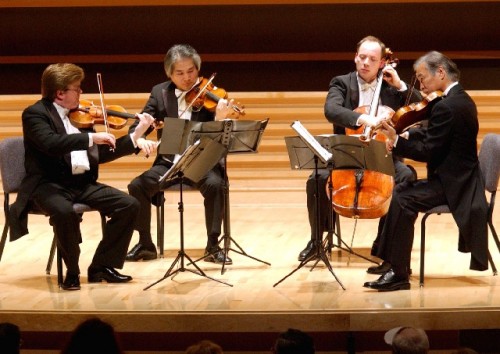
The last concert of the Princeton University Concerts 2010-2011 season  featured the renowned  Tokyo String Quartet. The program consisted Mozart Quartet No. 15 in D Minor, Takemitsu String Quartet No. 1 "A Way A Lone," and Beethoven Quartet in B-flat Major, Op. 130.

The program itself is a stormy one. Melanchoically sublime. According to the program notes, the pieces are tied together by "influence," all of the pieces being greatly influenced by previous composers (Mozart by Haydn, Takemitsu by post-Romanticists, and Beethoven by Handel). It is interesting to note that all of these pieces were later works from each composer's life. What's more interesting is that these later works are all some of the most tumultuous pieces of each composer, and I think it is this character that defines this concert and ties together the pieces, more so than the influence. For instance, the Mozart Quartet No. 15 is the only quartet that Mozart had written in a minor key (D minor--interesting, the same key as the only minor piano concerto Mozart had written, Piano Concerto No. 20). And as for the Beethoven, excluding the infamous "Great Fugue," Op. 133 (the last piece Beethoven had written--horribly painful as Beethoven's testament to the destruction of music), the Op. 130 is one of the greatest, and most unpredictably contrasting Beethoven string quartet. Now for the Takemitsu, I am unfamiliar with his work, but Quartet No. 1 was also composed later in this contemporary composer's life (1981), and was literally (or shall I say, musically) governed by the word, "SEA" (Eb (S corresponding to German pitch designation, E, and A). In this case, the SEA was tempestuous indeed. I thought the program selection in itself already set apart this concert from others. It was definitely one of the most "emotional" concerts I've attended, one reason being because all the pieces were so profound. I treasure concerts for that emotional experience, and I certainly got it here (just maybe a bit much though).

Now many sublime and thunderous things happened in each piece, but there was one eerie external and internal instance of it that I must share. Some sublime thunder happened during the Cavatina of the Beethoven. Literally and figuratively.  This movement is the definition of sublime. So much beauty and sorrow. It is said that Beethoven wept when he heard this in his head. This piece was actually sent to the heavens (okay, space--it was sent on the Voyager mission into space). What is truly uncanny is that during this movement (shortly after the heartwrenching "Beklemmt" passage, in which the first violin is "choked up" in anguished free recitative) a rumble of thunder resonated throughout the concert hall (there was a storm outside). It was as if the Gods were responding to such human suffering and sorrow; as if Beethoven had firmly said from the sky, "and let it be no more." But alas, it continues. Thank goodness it does. What would be a world with no suffering? A world without happiness?

Of course, the Tokyo String Quartet was phenomenal. I'd like to give a special shout out to the violist and cellist. In the rarer moments when I felt like things were getting rushed, the violist played with the "pauses" (but not pauses, just the inclination of a pause...) needed. I thought the violist played with the most conviction, mainly because he really played the silences. And the cellist, my goodness that deep, rich, sound gives me the chills just thinking about it! I've always been partial to cellos, but what I heard from this cello really resonated through my body and warmed it.

After the concert at the reception, I was very lucky to have gotten a chance to talk to one of the quartet members, Kikuei Ikeda (violin) and to express how much I enjoyed their performance. He was really pleased and asked me if I played any instruments, to which I replied that I was minoring in piano performance. His next response was completely unexpected and humble. He told me how exceptionally talented he thought us undergraduate musicians were (more so than graduate students), how he thought it was amazing how we were so intelligent and dedicated to our academic studies and yet exceptional musicians as well, referencing his experience teaching undergrad musicians at Yale.  Well, those words awakened me like the thunder did. I was really speechless, for I would have never imagined, this world-renowned musician felt humbled by us! It's really amazing how fast perspectives can shift, how fast relationships can change; how stepping outside of your own shoes for a while makes the world a different place. Music does that in so many ways, direct (like the concert), and indirect (like the reception), and turns an otherwise normal night into one of sublime thunder.

Friday, March 4, 2011

3D Audio Craziness!

Well, in light of the dearth of posts, I must admit things have been pretty crazy for me lately. Certainly crazy in more ways than one, but here is kind of craziness you want to hear about, I promise!

Professor Edgar Chouieri, professor of Mechanical Engineering at Princeton, gave dinner discussion last Friday, Feb. 25, titled "3D Audio" as part of an art and science lecture series organized by the newly formed student group, Music in Mind. Here was the event description:
Lecture and Dinner brought to you by the Music in Mind (MiM) group:

An excerpt:
I’m about to hear a demonstration of Choueiri’s Pure Stereo filter, which promises “truly 3-D reproduction of a recorded soundfield.” Only a handful of people have heard his 3-D demo, but it’s already spawned awestruck hype, as well as preemptive rumblings of audiophile skepticism. -- Atlantic Monthly, March 2011.

So sure, that sounds pretty cool, but the lecture was way more than just cool! We actually got to hear 3D audio (if you're befuddled as to what 3D audio even means, bear with me for a while, or read the above article). Professor Chouieri brought in a small black rectangular device--one of those things that you might mistake for a pencil box--that played out sound in 3D. When I held black box (Chouieri's, not Tolman's) an arm's length away from my head, I heard bird sounds not only to the left and right of me (what regular speakers can do), but I could also hear a bird as if it were right next to my right ear, and another one just a little farther away, or another one a little behind me. I could hear actual depth in audio, and it was wonderfully uncanny. It was quite entertaining to see the looks of awe on everyone's faces (all 50 of us!) as the device was passed around the room.

You're wondering, how does this work? Well, the answer is surprisingly obvious--in the same way that 3D images work. (We witness here again how creativity and innovation arise from applying old concepts in new ways.) We see 3D images by eliminating cross-talk between the eyes. In the same way, we hear 3D sound by eliminating cross-talk between the ears. I'm being horribly vague, so please check out this video! It does a much better job at explaining this extremely fascinating stuff:


Professor Chouieri's going to California in a few weeks to talk with the movie makers. Imagine having 3D audio in the movie theatres, and then 3D audio TV, 3D audio CDs...! Professor Chouieri offered to show us his 3D Audio and Applied Acoustics Lab; we're working on organizing groups to visit for Music in Mind and perhaps even working with him on the creation of a 3D audio musical project. Crazy awesome!

Saturday, December 18, 2010

Sinfonia Concert: A Review

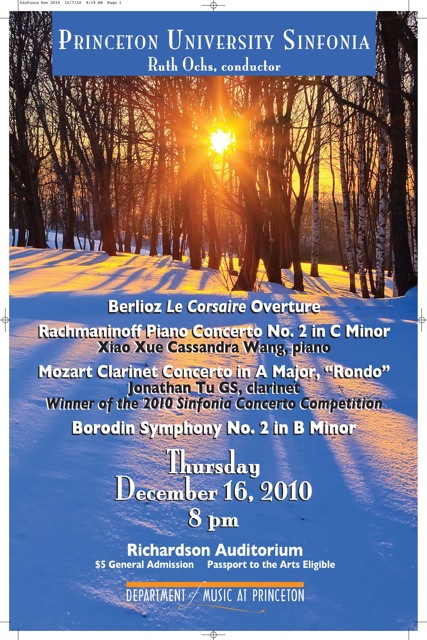
The Princeton University Sinfonia gave a fun-spirited concert on December 16 at Richardson Auditorium, with Ruth Ochs as conductor. The program consisted of  Berlioz’s Le Corsair Overture, Rachmaninoff’s Piano Concerto No. 2 (Cassandra Wang, piano), Rondo from Mozart’s Clarinet Concerto in A Major (Jonathan Tu, clarinet), and Borodin’s Symphony No. 2.

Berlioz’s Le Corsair Overture served as a riveting, bombastic opening to the concert, with Berlioz’s typical “come to the greatest show on earth” feel. Berlioz wrote the original version of this overture in August 1844 at Nice and led its first performance in Paris on January 19, 1845, then called La Tour de Nice (The Tower of Nice). Although the orchestra started off a little shaky, with entrances that could have been more confident, things eventually came together as the melody unfolded in the first section. Finally, the booms of the tympani resonating throughout the hall and the blaring brass served as a grandiose end to the beginning of a lively concert.

From such bombastic show of display, we are brought into another type of display: subtle virtuosity in Rachmaninoff’s famous Piano Concerto No. 2, composed in 1900-1901 and premiered with Rachmaninov himself as the soloist on November 9, 1901, in Moscow. I emphasize “subtle” virtuosity despite the obvious technical difficulty of the piece as a compliment to Cassandra Wang, the pianist. Cassandra glides through the runs with seeming effortlessness, and makes the most difficult of passages seem easy. Her playing reminds me of that of Yefin Bronfman’s, with a stoic body concealing the most expressive sounds. Her tone is warm and lyrical, taking the listener sighing into a far away dreamscape, especially in the beautiful adagio sostenuto. Cassandra deserves special commendation for her discerning ability to stay with the orchestra. The orchestra took the piece overall much slower than it is normally played, especially in Mvt. I and III, yet Xiao was able to restrain herself from the urge to rush (although noticeable) extremely well and patiently.  Although being greatly under tempo, and intonation issues in soloists (oboe), Cassandra’s solid and expressive performance made this piece the highlight of the concert.

Leaving behind the brilliant Romanticism of Rachmaninoff and the piano, we are transported to the wonderfully Classical world of Mozart and the clarinet in the Rondo from Mozart’s Clarinet Concerto in A Major. Mozart famous and only concerto for clarinet, known for its delicate interplay between orchestra and soloist, was written in 1791 for the clarinetist Anton Stadler. The clarinetist of the Sinfonia concert was Jonathan Tu, a graduate student at Princeton University and winner of the 2010 Sinfonia Concerto Competition. Despite a beautiful and warm tone, Jonathon had some trouble with his embouchure and excess air was often heard as he played. Nevertheless, the piece was quite enjoyable, maybe even a little too pleasant. In a way, the Mozart sounded a little too “perfect,” too “nice.” What was lacking in this performance, in both the orchestra and the soloist, was the feel of Mozartian whimsicality and playfulness. The dynamics were a little flat, and more contrasts would have made the experience more “fun,” in the playful Mozart style.

Finally, the concert ended with the heroic Borodin Symphony No. 2. The symphony was composed intermittently between 1869 and 1876, and is considered the most important large-scale work completed by the composer himself. Again, unconfident entrances took away from the boldness of the piece, especially in the opening sectional entrances of the Allegro theme. However, as the piece progressed, some really nice sounds started to come together. The double-tonguing of the brass in the Scherzo was effective in creating a underlying current of arousal, the vibratos of the strings created a wonderfully evanescent sound effect in the Andante, and the strong brassy sound at the end Finale served as a bold conclusion of finality. Sinfonia performed a concert of many popular delights in a more casual atmosphere. Though not a world-class orchestra, or the PUO, Sinfonia transports us to various places of musical adventure in a less intense manner.

Wednesday, June 9, 2010

The Art of Science | Princeton University 2010 Art of Science Exhibition

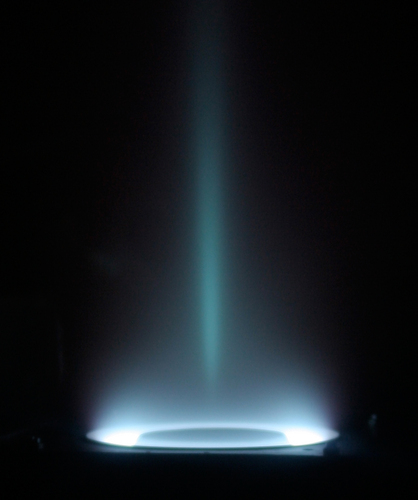
Princeton Art of Science Competition First Prize: Xenon Plasma Accelerator
When studying art and science, we typically look at the science of art, but let's flip things around a little, and look into the art of science.

The Princeton University 2010 Art of Science Competition is about finding art in original scientific research. Check out these ingenious works of art at the Art of Science 2010 Gallery. Here is a description of the exhibition from the website:
The 45 works chosen for the 2010 Art of Science exhibition represent this year’s theme of “energy” which we interpret in the broadest sense. These extraordinary images are not art for art’s sake. Rather, they were produced during the course of scientific research. Entries were chosen for their aesthetic excellence as well as scientific or technical interest.
I'd like to share an anecdote of my own, on a somewhat related relationship between art and science. A chemistry professor of mine, during our study of those colorful transition metals, loved to remark, "inorganic chemistry is intrinsically beautiful." He would lay out various transition metals in weighing vials for us to see, bright vivid blues, reds, greens, etc--very beautiful indeed. And then, instead of simply saying, "Today, we are learning about transition metals", he would ask us, "Why are transition metals so beautifully colored?" And by answering that question (which is much more difficult to answer than first meets the eye!), we discovered how transition metals worked--the transitions of energy involved, the orbital interactions, etc. (Perhaps an artistic rendering of transition metals would have been a good candidate for the 2010 Art of Science Competition's theme of "energy".) So, through our exploration of the aesthetics of transition metals, we developed a scientific understanding as well. Indeed, science itself is, as my chemistry professor would say, "intrinsically beautiful."