Search the Synapse

Showing posts with label art of science. Show all posts

Monday, September 24, 2012

Escher, Chopin, and String Theory

A reflection on "String Theory and Little Bangs" with Prof. Gubser
In a dinner discussion with the Princeton society, "Music in Mind," Princeton Physics professor, Steven Gubser, shared with a group of around 45 students his research in using string theory to describe collisions of heavy ions. Along the way, he made some creative relations to art and music. I'd like to share them here:

1) The vibrational modes of a superstring are like the overtones of a piano string, allowing blends of overtones to create a note. One difference, however, is that the vibrational modes of a superstring are much less constrained than the possible overtones of a piano string's. 

2) Professor Gubser explains how a hyperbolic geometry, AdS5, describes the geometry of D3-branes in a similar manner as an Escher artwork, "Angels and Demons:"


In Escher's artwork, the big angels are the same shape as the little angels, making the elements conformal.  It is a self within a self. For example, the large angels and small angels may be distorted from each other, but in the end, they are still angels. The theory of real-world gluons and quarks is likewise approximately conformal.

3) Finally, in the Q and A session, Professor Gubser left us with a general statement about a similar type of thinking within musicians and physicists. That is, namely, how to reconcile conflicting or seemingly opposing items into a fluid whole. He gives the example of Chopin, who smoothly meshed a 3 against 4 right hand vs left hand rhythm in his famous "Fantasie-Impromptu:" 

Lisewise, Professor Gubser argues that string theorists consistently must reconcile experimental data with theory, to see how the two could become consistent even in the face of seemingly inconsistent data.

Talk Description:
"String theory and little bangs"with Professor Steven Gubser, Princeton Physics departmenton Monday, September 24, 6-7 pm at the Mathey Firestone Society Room 
String theory is an attempt to describe all of fundamental physics starting from microscopic, vibrating strings.  In recent years there have been some remarkable successes in using stringtheory to describe collisions of heavy ions, which recreate the conditions present in the universe about a microsecond after the big bang.  I'll summarize these developments, introducing some of the personalities involved and using analogies to music and art where I can. String theory has been called the "theory of everything." It seeks to describe all the fundamental forces of nature. It encompasses gravity and quantum mechanics in one unifying theory. But it is unproven and fraught with controversy. 
Professor Steven Gubser is professor of physics at Princeton University (you may know him as your PHY 102 professor). His research focuses on theoretical particle physics, especially string theory, and the AdS/CFT correspondence. He is a widely cited scholar in these and other related areas. He is the author of "The Little Book of String Theory," which offers a short, accessible, and entertaining introduction to one of the most talked-about areas of physics today.   
Webpages: http://www.princeton.edu/physics/people/display_person.xml?netid=ssgubser&display=facultyhttp://wwwphy.princeton.edu/~ssgubser/

Friday, July 20, 2012

Artistic Synthesis and Synthetic Art

There’s hardly a thing that a man can name
Of use or beauty in life’s small game
But you can extract in alembic or jar
From the "physical basis" of black coal-tar-
Oil and ointment, and wax and wine,
And the lovely colors called aniline;
You can make anything from a salve to a star,
If you only know how, from black coal-tar.

-Punch

For the creators out there--artists and musicians, scientists, humanists, engineers, I recommend this article: In Praise of Synthesis by Roald Hoffman.

As you open the article and start to groan because you see esoteric chemical molecules, hang in there and keep reading, and you'll find the hallmarks that link scientists and artists, similar things that President Shirley Tilghman mentioned in her Art of Science talk. Roald Hoffman was a recipient of the 1981 Nobel Prize in Chemistry, and these are his words:

Chemical synthesis not only shares some of the aesthetic criteria of art; I think it is art. At the same time, it is logic. 
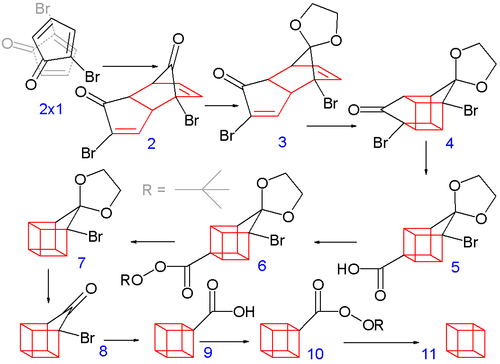
Consider the kind of art and creation that happens in making cubane:

The details of how it happens may be enigmatic, but surely it is obvious that a great process--part by design, part by chance, planned and experimented--occurs to create a elegant product. I agree, this is art. This is also logic. Wherein logic is art in this case, I also think, and I'm sure Escher would agree, that art is logic. Witness a Escher tessellation:

The mix of planning, experimentation, part by chance and part by design aspects of chemical synthesis are no doubt manifested in this beautiful, clever work of art--as in the beautiful, clever synthesis of cubane.

Beautiful logic (I mean art), isn't it?

Friday, June 8, 2012

President Shirley Tilghman on Art and Science


Shirley Tilghman, President of Princeton University, was invited to speak on the Art of Science by the student group on campus, Music in Mind. In her talk, she described ways that artists and scientists were similar and shared similar ways of thinking. Having raised a sound engineer and art historian, and a molecular biologist herself, she shared with us eager students her thoughts on what is required in both art and science:

1. Creativity and imagination 
2. Seeing the world orthogonal to what is mainstream
Elizabeth Blackburn studied tetrahymena, the ends of chromosomes--an area few thought useful to study. She discovered the ends of these structures and won the Nobel Prize for her work. Similarly, the impressionists in art saw new ways of approaching art and representing the natural world. 
3. Intense observations
4. Trying to reveal something new in the natural world
5. Appreciation of beauty
Both artists and scientists try to make the world a better place by enriching the experience of being human. 

President Shirley Tilghman is a strong supporter of the Lewis Center for the Arts on the Princeton University campus. Recently, she gave a graduation commencement speech on the importance of a liberal arts education, citing the value of interdisciplinary perspectives on future innovation. 

Wednesday, June 8, 2011

[The artist]

[The scientist] does not study nature because it is useful; he studies it because he delights in it, and he delights in it because it is beautiful. If nature were not beautiful, it would not be worth knowing, and if nature were not worth knowing, life would not be worth living.

--Henri Poincare, physicist

Wednesday, September 1, 2010

Princeton News: Sculpture in chemistry lab bonds science and art

Princeton News: Sculpture in chemistry lab bonds science and art

Here we witness another example of "artscience", a term I stole from David Edwards, author of Artscience and founder of Le Laboratoire, an artscience center in Paris.
Kendall Buster has delved into art and science over the course of her career. The work she created for Princeton University's new Frick Chemistry Laboratory has emerged from both of her worlds.
The sculpture brings to mind shapes seen through a microscope lens. It was inspired by models employed to represent molecular structures, according to the artist. 
It is no wonder that the beauty of cellular structures are akin to the elegance of architecture, for nature's designs are naturally the most stable and intelligent, with simple elegance. This reminds me of the work of Don Ingber from Harvard University, who defended that cellular structure was like a Buckminster Fuller tensegrity structure.

Wednesday, June 9, 2010

The Art of Science | Princeton University 2010 Art of Science Exhibition

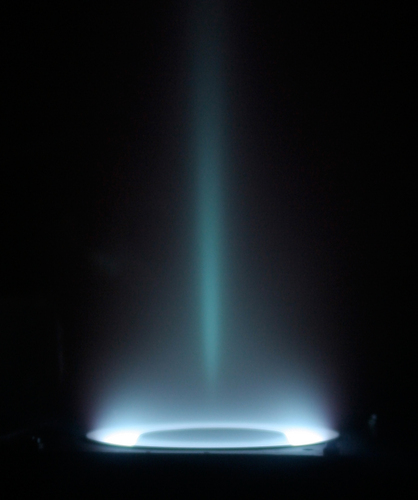
Princeton Art of Science Competition First Prize: Xenon Plasma Accelerator
When studying art and science, we typically look at the science of art, but let's flip things around a little, and look into the art of science.

The Princeton University 2010 Art of Science Competition is about finding art in original scientific research. Check out these ingenious works of art at the Art of Science 2010 Gallery. Here is a description of the exhibition from the website:
The 45 works chosen for the 2010 Art of Science exhibition represent this year’s theme of “energy” which we interpret in the broadest sense. These extraordinary images are not art for art’s sake. Rather, they were produced during the course of scientific research. Entries were chosen for their aesthetic excellence as well as scientific or technical interest.
I'd like to share an anecdote of my own, on a somewhat related relationship between art and science. A chemistry professor of mine, during our study of those colorful transition metals, loved to remark, "inorganic chemistry is intrinsically beautiful." He would lay out various transition metals in weighing vials for us to see, bright vivid blues, reds, greens, etc--very beautiful indeed. And then, instead of simply saying, "Today, we are learning about transition metals", he would ask us, "Why are transition metals so beautifully colored?" And by answering that question (which is much more difficult to answer than first meets the eye!), we discovered how transition metals worked--the transitions of energy involved, the orbital interactions, etc. (Perhaps an artistic rendering of transition metals would have been a good candidate for the 2010 Art of Science Competition's theme of "energy".) So, through our exploration of the aesthetics of transition metals, we developed a scientific understanding as well. Indeed, science itself is, as my chemistry professor would say, "intrinsically beautiful."