The air is thick, saturated with flying bonds, proton transfers, reagents. Hundreds of students, and inside every head holds a whirlwind of activity. 10 seconds left...Frantic scribbling...5....turning of pages...3....erasing...
And suddenly it's over. The anxiety, confusion, frustration, hours of toil. Over.
The air is empty. The flashes of insight, the beauty of creation, the elegance of pushing arrows. Over.
Last exam of the year. Organic chemistry. Over.
And who would have thought, that one might discover so much beauty in it? Organic chemistry is one of the most artistic experiences I've been through. As musician and dancer, that's saying something. Seems counterintuitive, doesn't it? Chemistry is often thought to be the realm of the realists, for what could be more specific and real than molecules--the basic units of life, and synthetic “life”? Yet, there’s so much ambiguity, so much abstractness and postulating to be found in organic chemistry (like science in general, the ambiguity and unknowns make up the great art in science). No explanation is set in stone…perhaps the molecule goes through a cationic transition state, or perhaps the reaction involves a concerted displacement…perhaps the more bulky substituent migrates to relieve steric strain, or perhaps it can stabilize positive charge better... Certainly, the ambiguous and abstract can be confusing and daunting, but they are ever so interesting and artistic as well.
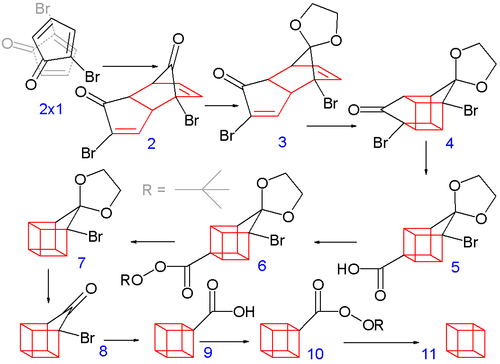
But organic chemistry is creative for another more obvious reason: it holds the power of creation. Synthesis. That’s a beautiful word. Organic chemists have to unique power to create new molecules--molecules with structural complexity that deserve to be on display in an art museum, molecules that mimic the wonder of nature, molecules that hold the power of treating diseases. Molecules are a work of art in themselves. Take, for example, this simply elegant molecule (which we considered how to synthesize in one of our problem sets!):
And take, for another example, this complex architectural sculpture (synthesized in the lab of my chemistry professor,
EJ Sorensen) with antibiotic properties:
We have science museums and art museums. One day, I shall like to see a science art museum, with molecules like these two certainly included, along displays of art such as the ones found in the Art of Science Gallery (see
previous post).
And it goes even further. When I said organic chemistry was artistic, I didn't mean just the subject itself, but also the process of learning organic chemistry. What do I mean by that? Well, let's just say, learning organic chemistry is like practicing piano (it's amazing how many times I've found myself making this analogy during my study of organic chemistry). It takes regular practice, often repetitive and seemingly tedious, to really nail down a concept. It's a doing, not watching thing. You can't just study the music score and expect to be able to play a piece. Similarly, in ballet class, our instructor always would say, "Go ahead, practice the moves! This is not school, you can't just study the moves and expect to be able to do them." Well, our instructor was half right--in the case of organic chemistry, dancing is certainly is like school indeed. In organic chemistry, you can't just study the concepts, you have to do chemistry "with a pencil"--you have to actually work out problems, and make mistakes. Frustration. It's a wonderful part of the artistic process. Because without it, we wouldn't have the wonderful sense of reward experienced when we overcome our challenges.
Organic chemistry. Over? Not quite.
Because organic chemistry, like music making, is process that teaches you to think a bit more artistically, and that, --that will continue for the rest our lives.