Search the Synapse

Showing posts with label art. Show all posts

Monday, September 24, 2012

Escher, Chopin, and String Theory

A reflection on "String Theory and Little Bangs" with Prof. Gubser
In a dinner discussion with the Princeton society, "Music in Mind," Princeton Physics professor, Steven Gubser, shared with a group of around 45 students his research in using string theory to describe collisions of heavy ions. Along the way, he made some creative relations to art and music. I'd like to share them here:

1) The vibrational modes of a superstring are like the overtones of a piano string, allowing blends of overtones to create a note. One difference, however, is that the vibrational modes of a superstring are much less constrained than the possible overtones of a piano string's. 

2) Professor Gubser explains how a hyperbolic geometry, AdS5, describes the geometry of D3-branes in a similar manner as an Escher artwork, "Angels and Demons:"


In Escher's artwork, the big angels are the same shape as the little angels, making the elements conformal.  It is a self within a self. For example, the large angels and small angels may be distorted from each other, but in the end, they are still angels. The theory of real-world gluons and quarks is likewise approximately conformal.

3) Finally, in the Q and A session, Professor Gubser left us with a general statement about a similar type of thinking within musicians and physicists. That is, namely, how to reconcile conflicting or seemingly opposing items into a fluid whole. He gives the example of Chopin, who smoothly meshed a 3 against 4 right hand vs left hand rhythm in his famous "Fantasie-Impromptu:" 

Lisewise, Professor Gubser argues that string theorists consistently must reconcile experimental data with theory, to see how the two could become consistent even in the face of seemingly inconsistent data.

Talk Description:
"String theory and little bangs"with Professor Steven Gubser, Princeton Physics departmenton Monday, September 24, 6-7 pm at the Mathey Firestone Society Room 
String theory is an attempt to describe all of fundamental physics starting from microscopic, vibrating strings.  In recent years there have been some remarkable successes in using stringtheory to describe collisions of heavy ions, which recreate the conditions present in the universe about a microsecond after the big bang.  I'll summarize these developments, introducing some of the personalities involved and using analogies to music and art where I can. String theory has been called the "theory of everything." It seeks to describe all the fundamental forces of nature. It encompasses gravity and quantum mechanics in one unifying theory. But it is unproven and fraught with controversy. 
Professor Steven Gubser is professor of physics at Princeton University (you may know him as your PHY 102 professor). His research focuses on theoretical particle physics, especially string theory, and the AdS/CFT correspondence. He is a widely cited scholar in these and other related areas. He is the author of "The Little Book of String Theory," which offers a short, accessible, and entertaining introduction to one of the most talked-about areas of physics today.   
Webpages: http://www.princeton.edu/physics/people/display_person.xml?netid=ssgubser&display=facultyhttp://wwwphy.princeton.edu/~ssgubser/

Friday, July 20, 2012

Artistic Synthesis and Synthetic Art

There’s hardly a thing that a man can name
Of use or beauty in life’s small game
But you can extract in alembic or jar
From the "physical basis" of black coal-tar-
Oil and ointment, and wax and wine,
And the lovely colors called aniline;
You can make anything from a salve to a star,
If you only know how, from black coal-tar.

-Punch

For the creators out there--artists and musicians, scientists, humanists, engineers, I recommend this article: In Praise of Synthesis by Roald Hoffman.

As you open the article and start to groan because you see esoteric chemical molecules, hang in there and keep reading, and you'll find the hallmarks that link scientists and artists, similar things that President Shirley Tilghman mentioned in her Art of Science talk. Roald Hoffman was a recipient of the 1981 Nobel Prize in Chemistry, and these are his words:

Chemical synthesis not only shares some of the aesthetic criteria of art; I think it is art. At the same time, it is logic. 
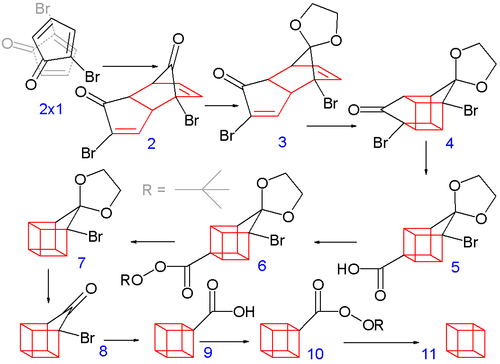
Consider the kind of art and creation that happens in making cubane:

The details of how it happens may be enigmatic, but surely it is obvious that a great process--part by design, part by chance, planned and experimented--occurs to create a elegant product. I agree, this is art. This is also logic. Wherein logic is art in this case, I also think, and I'm sure Escher would agree, that art is logic. Witness a Escher tessellation:

The mix of planning, experimentation, part by chance and part by design aspects of chemical synthesis are no doubt manifested in this beautiful, clever work of art--as in the beautiful, clever synthesis of cubane.

Beautiful logic (I mean art), isn't it?

Friday, March 16, 2012

Mystery's Seduction

This poem was written a few months ago, about someone in particular, by someone in particular.

these words are

more than they
are but really
only a façade
of the person
you are it’s
easy to hide
behind words which
have structure and
form but what
happens when they
don’t poetry is
fickle and loved
for mystery most
by the poet


You may know this person.


Ambiguity holds us. We wonder what it means. The mysterious. The unknown. And though we might not always delight in it (though we often do), there's no denying we are innately drawn to decoding it. A simple phrase like "Will you be my asparagus?" delights us because we ponder what the chocolate cake it might mean. ...as does the cake part. (hm, I must be hungry at the moment.)

What is it that is so appealing about the mad scientist, or mad musician? Why is this image so popular in society? It's because there's this wonderful sense of magic, or mystery of how they function. The mad genius is so fascinating because they seem to exist in a world completely unknown to you. Sometimes they seem possessed with a disease, and at the same time this "disease" makes them interesting. 


As observers we are quick to admonish against defining someone by their disease. But what happens when the "disease" is something the victim purposefully perpetrates, whether consciously or unconsciously? Chopin's pale, white, thin figure, his (do I dare say) effeminate manner of presentation, garners him intrigue by the audience. In a case like this, is Chopin the victim, or are we, the audience?


And so you find this post utterly incomprehensible. Good. I have caught your interest.

Monday, May 16, 2011

The Art of Organic Chemistry

The air is thick, saturated with flying bonds, proton transfers, reagents. Hundreds of students, and inside every head holds a whirlwind of activity. 10 seconds left...Frantic scribbling...5....turning of pages...3....erasing...

And suddenly it's over. The anxiety, confusion, frustration, hours of toil. Over.
The air is empty. The flashes of insight, the beauty of creation, the elegance of pushing arrows. Over.
Last exam of the year. Organic chemistry. Over.

And who would have thought, that one might discover so much beauty in it? Organic chemistry is one of the most artistic experiences I've been through. As musician and dancer, that's saying something. Seems counterintuitive, doesn't it? Chemistry is often thought to be the realm of the realists, for what could be more specific and real than molecules--the basic units of life, and synthetic “life”? Yet, there’s so much ambiguity, so much abstractness and postulating to be found in organic chemistry (like science in general, the ambiguity and unknowns make up the great art in science). No explanation is set in stone…perhaps the molecule goes through a cationic transition state, or perhaps the reaction involves a concerted displacement…perhaps the more bulky substituent migrates to relieve steric strain, or perhaps it can stabilize positive charge better... Certainly, the ambiguous and abstract can be confusing and daunting, but they are ever so interesting and artistic as well.

But organic chemistry is creative for another more obvious reason: it holds the power of creation. Synthesis. That’s a beautiful word. Organic chemists have to unique power to create new molecules--molecules with structural complexity that deserve to be on display in an art museum, molecules that mimic the wonder of nature, molecules that hold the power of treating diseases. Molecules are a work of art in themselves. Take, for example, this simply elegant molecule (which we considered how to synthesize in one of our problem sets!):

And take, for another example, this complex architectural sculpture (synthesized in the lab of my chemistry professor, EJ Sorensen) with antibiotic properties:

We have science museums and art museums. One day, I shall like to see a science art museum, with molecules like these two certainly included, along displays of art such as the ones found in the Art of Science Gallery (see previous post).

And it goes even further. When I said organic chemistry was artistic, I didn't mean just the subject itself, but also the process of learning organic chemistry. What do I mean by that? Well, let's just say, learning organic chemistry is like practicing piano (it's amazing how many times I've found myself making this analogy during my study of organic chemistry). It takes regular practice, often repetitive and seemingly tedious, to really nail down a concept. It's a doing, not watching thing. You can't just study the music score and expect to be able to play a piece. Similarly, in ballet class, our instructor always would say, "Go ahead, practice the moves! This is not school, you can't just study the moves and expect to be able to do them." Well, our instructor was half right--in the case of organic chemistry, dancing is certainly is like school indeed. In organic chemistry, you can't just study the concepts, you have to do chemistry "with a pencil"--you have to actually work out problems, and make mistakes. Frustration. It's a wonderful part of the artistic process. Because without it, we wouldn't have the wonderful sense of reward experienced when we overcome our challenges.

Organic chemistry. Over? Not quite.

Because organic chemistry, like music making, is process that teaches you to think a bit more artistically, and that, --that will continue for the rest our lives.

Tuesday, September 28, 2010

Richard Schechner: "Art is cognitive as well as passionate...

...and theory is passionate as well as cognitive."

Today I had the wonderful opportunity of meeting Richard Schechner, who could be termed as one of the founders of Performance Studies--the study of the everyday life of performance. In addition to the brilliance of who he is and what he's done (Professor of Performance Studies at the Tisch School of the Arts, New York University, editor of TDR: The Drama Review, and artistic director of East Coast Artists, one of the founders of the Performance Studies department of the Tisch School of the Arts, New York University (NYU), the list goes on and on...), I'm inspired by his philosophy on life, and on the path to knowledge and ultimately wisdom.

Through the eyes of Schechner, knowledge is seeing things together, as in seeing wild imagination in the hard sciences (string theory, gluons?) and concrete theory in art. I see this as creativity as well, through the lens of Rosenthal, who describes the creative "janusian" process as seeing two distinct areas of space into one. I admire Schechner's passion behind idea, for he is "passionate about scholarship as if passionate about art," and makes a great statement again those critics of neuroaesthetics arguing that the statement "I don't want to study the science of art because I don't want to ruin art" is NOT TRUE. Schechner tackles a problem by pursuing a problem to the end, and seeing connections (and we can see he is very successful!)

Schechner comes up with many clever axioms, some of which I’d like to share (roughly quoted):
“Ignorance (of anything) to infinity is constant.”
“Improvisation must have structure. Structure must have improvisation.”
“Art is constantly as restatement, manipulation…”
“Serendipity is important.”

Here’s to another “artscientist,” as Daniel Edwards, author of Artscience, would say. And here’s to the artscientist within us all!

Wednesday, September 1, 2010

Princeton News: Sculpture in chemistry lab bonds science and art

Princeton News: Sculpture in chemistry lab bonds science and art

Here we witness another example of "artscience", a term I stole from David Edwards, author of Artscience and founder of Le Laboratoire, an artscience center in Paris.
Kendall Buster has delved into art and science over the course of her career. The work she created for Princeton University's new Frick Chemistry Laboratory has emerged from both of her worlds.
The sculpture brings to mind shapes seen through a microscope lens. It was inspired by models employed to represent molecular structures, according to the artist. 
It is no wonder that the beauty of cellular structures are akin to the elegance of architecture, for nature's designs are naturally the most stable and intelligent, with simple elegance. This reminds me of the work of Don Ingber from Harvard University, who defended that cellular structure was like a Buckminster Fuller tensegrity structure.

Monday, July 26, 2010

When Music Meets Brain?

I came across this beautiful picture, titled "When Music Meets Brain." But I'm craving to know, what is it? A neural structure involved in music processing, or an artistic rendering of a creative mind?

Though I can't quite understand it, we can still glean something from it. It's another example of the philosophy of neuroaesthetics: Understanding the science behind the art allows us to enhance our appreciation of both science and art.

Wednesday, July 21, 2010

A Mona Lisa Mystery: The Science Behind the Smile


Da Vinci’s Mona Lisa is celebrated for her mysterious smile. At every glance, her countenance seems to change slightly. Upon turning our gaze away from her mouth, we may experience the strange sensation that she is smiling more, as if mocking us. Yet, as soon as we focus our eyes once again upon her mouth, we find she is smiling just as she was before. Is there a method behind this seeming madness? Is it a trick of the light, or a trick of the mind?

Margaret Livingstone (2002), Harvard neuroscientist, suggests that this phenomenon may be because Mona Lisa’s smile is more apparent when seen in coarse resolution. Therefore, in the periphery of our vision, where there are larger receptive fields that are poor in perceiving detail, Mona Lisa appears to be smiling more. When we look directly at Mona Lisa’s mouth, we are able to process detail much more effectively because the receptive fields of cells in our central vision (fovea cells) are much smaller. As a result, Mona Lisa’s smile fades as we focus our gaze to her mouth. In the picture below, note how Mona Lisa's seems to smile more in coarse resolution (as in peripheral vision), and smile less in fine resolution (as in central vision).


From Vision and Art: The Biology of Seeing, by M. Livingstone, 2002, p.73
Another theory for the appeal of Mona Lisa’s smile is that angles of her mouth activate area V5 (the area for processing motion) and the frontal cortex. Neurologist A. Chakravarty (2010), author of "Mona Lisa's smile: a hypotheses based on a new principle of art neuroscience," suggested that Da Vinci “[introduced] an element of implicit dynamism, an imagination of movement of a smiling face, in the painting to increase the aesthetic value of his art work”. According to Chakravarty, Mona Lisa’s smile is appealing because it calls upon one’s imagination of movement. However, Chakravarty’s claim seems quite broad, and does not specify what is it about Mona Lisa’s smile that makes it any different from other subtle smiles that also call upon one’s imagination of motion.

Despite the detailed neuroaesthetics of Mona Lisa’s mouth, we have barely begun to scratch the surface of this great masterpiece. In addition to the enigma of Mona Lisa’s smile, there is still, for example, the enigma of how her eyes seem to follow the viewer and the dynamics of the background. Most importantly, there is the profusion of cultural questions regarding the style of the time period, the identity of Mona Lisa, and Mona Lisa’s relationship to Da Vinci . These questions are important aspects of art that neuroaesthetics could never encompass to address.

Wednesday, June 9, 2010

The Art of Science | Princeton University 2010 Art of Science Exhibition

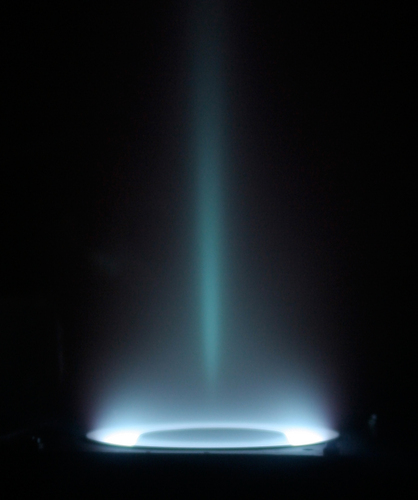
Princeton Art of Science Competition First Prize: Xenon Plasma Accelerator
When studying art and science, we typically look at the science of art, but let's flip things around a little, and look into the art of science.

The Princeton University 2010 Art of Science Competition is about finding art in original scientific research. Check out these ingenious works of art at the Art of Science 2010 Gallery. Here is a description of the exhibition from the website:
The 45 works chosen for the 2010 Art of Science exhibition represent this year’s theme of “energy” which we interpret in the broadest sense. These extraordinary images are not art for art’s sake. Rather, they were produced during the course of scientific research. Entries were chosen for their aesthetic excellence as well as scientific or technical interest.
I'd like to share an anecdote of my own, on a somewhat related relationship between art and science. A chemistry professor of mine, during our study of those colorful transition metals, loved to remark, "inorganic chemistry is intrinsically beautiful." He would lay out various transition metals in weighing vials for us to see, bright vivid blues, reds, greens, etc--very beautiful indeed. And then, instead of simply saying, "Today, we are learning about transition metals", he would ask us, "Why are transition metals so beautifully colored?" And by answering that question (which is much more difficult to answer than first meets the eye!), we discovered how transition metals worked--the transitions of energy involved, the orbital interactions, etc. (Perhaps an artistic rendering of transition metals would have been a good candidate for the 2010 Art of Science Competition's theme of "energy".) So, through our exploration of the aesthetics of transition metals, we developed a scientific understanding as well. Indeed, science itself is, as my chemistry professor would say, "intrinsically beautiful."