Search the Synapse

Showing posts with label science. Show all posts

Friday, December 20, 2013

To Doubt What is Undoubtedly Right

Radiolab: How do you solve a problem like Fritz Haber?
What happens: Haber wins the Nobel prize for converting Nitrogen into a nutritionally useful form and solves a food crises. Haber then uses the same process for gas warfare (Chlorine gas) and seems to delight in killing as many Allies as he can with it. His wife (also a gifted scientist) is horrified and argues for him to stop on moral grounds. He doesn't. She commits suicide. The next day, Haber goes to war to continue gas warfare leaving his son with a dead mother. The son then commits suicide. When the Germans are defeated, Haber spends years trying to develop a scientific process to collect gold from the sea to pay off Germany's war debt. He fails. Hitler comes to power, and Haber (a Jew) leaves the country. Nazi Germany uses a Haber-derived process to exterminate Jews (including Haber's extended family) in gas chambers.

It's a very gripping listen (hopefully that shocking summary is enough to get you to hear the whole story)...and I think one that will hopefully influence us as we move forward as people who want to impact the world. (By the way, Radiolab is my favorite radio show - always gets me thinking in different ways - on moral and social issues, in questioning conventional psychological thought/analysis, and with feel-good/thinking-good stories & sound-effects.)

Haber's story also reminds me of Richard Wagner - a horribly anti-Semitic man who made great music. I still don't know how to answer the question my music professor posed to me two years ago: should Wagner's music be played publicly? http://www.jewishvirtuallibrary.org/jsource/anti-semitism/Wagner.html

I think the lessons boil down to not taking things to the extremes, to step back and doubt. In all those times we hate ourselves for doubting and falling in that uncertain limbo space, it's nice to know that doubt is good.  The "greater good" is a dangerous concept. As another Radiolab podcast quoted, what is "greater" and what is "good"? Perhaps there is no clear answer, and so we must always doubt what is undoubtedly right.

Friday, December 23, 2011

Music of the Universe

In seventh grade, my science teacher told us,

"There's no sound in space." 

Perhaps you were told this too? After all, space is a vacuum, and sound requires a medium to travel through, right?

Like so many of our cherished childhood "facts," the answer is yes...and no. I made this delightfully unsettling discovery this morning, while reading "For the Love of Physics" by MIT physics professor Walter Lewin (this book deserves a spot in the literary vesicle). It turns out that space is not a perfect vacuum (though a much better vacuum than any vacuum we could make on Earth...is "perfection" relative?):  Matter (mostly plasma) exists in space, and  therefore pressure waves, and thus sound, can be produced and propagated. There's actually lots of sound in space! The catch is, our ears can't hear those frequencies. So yes, space is a vacuum, but no, it's not a perfect vacuum. And yes, there's sound in space, but no, we can't hear the sound (and if we can't hear the sound, is it a "sound"? It's the age-old question, "If a tree falls in the wood and no one hears it, does it make a sound?"--see related post). 

Disappointing, isn't it? After a promising realization of sound in space, we still won't ever be able to hear the music of the cosmos? 

Once again, the answer is yes...and no. True, "the big bang produced a bass gong sound that now has a wavelength of about 500 million light-years, a frequency of about fifty octaves (a factor of 10^15) below anything our ears can hear" (For the Love of Physics). The good news is that astronomer Mark Whittle has reproduced the sounds of the big bang for us to listen to (small caveat: it's raised in pitch by 50 octaves and compressed in time from 100 million years into 10 seconds)!

Click to listen to the big bang:
Read about big bang acoustics here: http://www.astro.virginia.edu/~dmw8f/BBA_web/index_frames.html

Consider for a moment if the most basic units of the universe were like musical notes--resonant frequencies of unimaginably tiny strings. And these "musical notes" were what produced all our elementary particles (such as the electron). In effect, this is the basic tenet of string theory. And if string theory holds any ground (who knows if it does?), then the universe is a beautiful symphony of sound!

Of course, that depends on what you constitute "beauty" and "music" as. You've heard the "music" of the heavenly spheres. Now it's up to you to decide if that constitutes as music. The answer's probably yes...and no.

Tuesday, March 15, 2011

Music in Medicine at MA General Hospital: Dr. Conrad

Chronicles of Boston Breakout: Day 3
After the music therapy session, we went to the Massachusetts General Hospital to visit Dr. Conrad, a surgeon and the Director of the Music in Medicine Research group . Here is a bit of background information about Dr. Conrad:
Claudius Conrad, Director of Music in Medicine of the Department of Surgery and the Benson Henry Institute for Mind Body Medicine, is well-known for his work understanding the role of music in modern medicine. He holds an MD, a doctoral degree in stem cell biology, and a doctoral degree in music philosophy from the University of Munich. He has been awarded several honors for his work, including the Excellence in Research Award, the Leadership Award of the American College of Surgeons, Steinway Artist, and many others. As a trained concert pianist and lecturer, he promotes the scientific use of music in medicine at prominent institutions around the globe.
Dr. Conrad gave us an informative lecture on his research on how listening to music (Mozart) helps performance (performing surgical procedures and motor control tasks). The results of his studies show that listening to Mozart decreases stress (by measuring stress indicators in the blood), and improves motor performance. In one study, subjects were asked to perform motor tasks, similar to surgical procedure tasks, in either a silent, dichotic music, mental loading, or Mozart condition. The results showed that subject's speed and accuracy in the tasks increased in the Mozart condition. Also, the blood samples taken from the participants showed that those in the Mozart condition had lower indicators of stress and that nurses (blind to the study) rated those subjects as more relaxed. See the paper, "The effect of defined auditory conditions versus mental loading on the laparoscopic motor skill performance of experts" published in Surgical Endoscopy, 2010.

What really astounds me is how Dr. Conrad is able to do such research, be a surgeon, and a touring concert pianist at the same time. He told us he attended medical school and a music conservatory at the same time!

For more on the music in medicine research Dr. Conrad does, check out this video: "Music in Medicine--Dr. Conrad"

Tuesday, September 28, 2010

Richard Schechner: "Art is cognitive as well as passionate...

...and theory is passionate as well as cognitive."

Today I had the wonderful opportunity of meeting Richard Schechner, who could be termed as one of the founders of Performance Studies--the study of the everyday life of performance. In addition to the brilliance of who he is and what he's done (Professor of Performance Studies at the Tisch School of the Arts, New York University, editor of TDR: The Drama Review, and artistic director of East Coast Artists, one of the founders of the Performance Studies department of the Tisch School of the Arts, New York University (NYU), the list goes on and on...), I'm inspired by his philosophy on life, and on the path to knowledge and ultimately wisdom.

Through the eyes of Schechner, knowledge is seeing things together, as in seeing wild imagination in the hard sciences (string theory, gluons?) and concrete theory in art. I see this as creativity as well, through the lens of Rosenthal, who describes the creative "janusian" process as seeing two distinct areas of space into one. I admire Schechner's passion behind idea, for he is "passionate about scholarship as if passionate about art," and makes a great statement again those critics of neuroaesthetics arguing that the statement "I don't want to study the science of art because I don't want to ruin art" is NOT TRUE. Schechner tackles a problem by pursuing a problem to the end, and seeing connections (and we can see he is very successful!)

Schechner comes up with many clever axioms, some of which I’d like to share (roughly quoted):
“Ignorance (of anything) to infinity is constant.”
“Improvisation must have structure. Structure must have improvisation.”
“Art is constantly as restatement, manipulation…”
“Serendipity is important.”

Here’s to another “artscientist,” as Daniel Edwards, author of Artscience, would say. And here’s to the artscientist within us all!

Wednesday, June 9, 2010

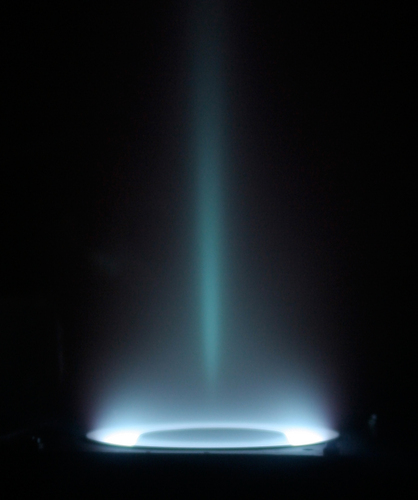
The Art of Science | Princeton University 2010 Art of Science Exhibition

Princeton Art of Science Competition First Prize: Xenon Plasma Accelerator
When studying art and science, we typically look at the science of art, but let's flip things around a little, and look into the art of science.

The Princeton University 2010 Art of Science Competition is about finding art in original scientific research. Check out these ingenious works of art at the Art of Science 2010 Gallery. Here is a description of the exhibition from the website:
The 45 works chosen for the 2010 Art of Science exhibition represent this year’s theme of “energy” which we interpret in the broadest sense. These extraordinary images are not art for art’s sake. Rather, they were produced during the course of scientific research. Entries were chosen for their aesthetic excellence as well as scientific or technical interest.
I'd like to share an anecdote of my own, on a somewhat related relationship between art and science. A chemistry professor of mine, during our study of those colorful transition metals, loved to remark, "inorganic chemistry is intrinsically beautiful." He would lay out various transition metals in weighing vials for us to see, bright vivid blues, reds, greens, etc--very beautiful indeed. And then, instead of simply saying, "Today, we are learning about transition metals", he would ask us, "Why are transition metals so beautifully colored?" And by answering that question (which is much more difficult to answer than first meets the eye!), we discovered how transition metals worked--the transitions of energy involved, the orbital interactions, etc. (Perhaps an artistic rendering of transition metals would have been a good candidate for the 2010 Art of Science Competition's theme of "energy".) So, through our exploration of the aesthetics of transition metals, we developed a scientific understanding as well. Indeed, science itself is, as my chemistry professor would say, "intrinsically beautiful."