Search the Synapse

Showing posts with label visual art. Show all posts

Thursday, September 1, 2011

Paul Bloom: The Origins of Pleasure

Another great TED talk.
Why do we like an original painting better than a forgery? Psychologist Paul Bloom argues that human beings are essentialists -- that our beliefs about the history of an object change how we experience it, not simply as an illusion, but as a deep feature of what pleasure (and pain) is.
Paul Bloom: The Origins of Pleasure


This video became a "rhyming event" for me today. I watched it just seconds before going to the home society where I've been playing piano for kids with developmental disabilities this summer. As I enter, I see that John, one of the kids, has a freshly-painted finger-painting sitting on his lap. It's of a heart. He says it's for me. That meant so much to me, and I though it was such a beautiful painting. Most people would probably look at it, see a blob of red and pink, and shrug.  But I'd rather have this painting than a Vermeer. So yes, it goes to show, the "history" of an object makes all the difference in our experience of it.

Paul Bloom brings up good points about our experience of music as well. The piece, 4'33 has been under scrutiny in relation to so many topics--how do we define music? how does the fact that Cage composed it change how we view the piece? I find it amusing that not only is 4'33 on iTunes, but you can enjoy it here on youtube performed by a full orchestra and a packed audience that gives it a standing ovation (and plenty of coughing between movements). The Joshua Bell "experiment" (in quotes because it wasn't really a controlled experiment) mentioned in the video has a slew of other factors involved as well, like the environment (I disagree with the video--the listeners in the noisy subway, busy with places to be, were not listening to the same Joshua Bell played in a perfectly acousted concert hall. "History" can't account for everything of course.

Once again, psychology has shown us the power of belief in shaping our experiences.

The mind is its own place,
and in itself
Can make a Heaven of Hell,
a Hell of Heaven

--John Milton

Wednesday, July 21, 2010

A Mona Lisa Mystery: The Science Behind the Smile


Da Vinci’s Mona Lisa is celebrated for her mysterious smile. At every glance, her countenance seems to change slightly. Upon turning our gaze away from her mouth, we may experience the strange sensation that she is smiling more, as if mocking us. Yet, as soon as we focus our eyes once again upon her mouth, we find she is smiling just as she was before. Is there a method behind this seeming madness? Is it a trick of the light, or a trick of the mind?

Margaret Livingstone (2002), Harvard neuroscientist, suggests that this phenomenon may be because Mona Lisa’s smile is more apparent when seen in coarse resolution. Therefore, in the periphery of our vision, where there are larger receptive fields that are poor in perceiving detail, Mona Lisa appears to be smiling more. When we look directly at Mona Lisa’s mouth, we are able to process detail much more effectively because the receptive fields of cells in our central vision (fovea cells) are much smaller. As a result, Mona Lisa’s smile fades as we focus our gaze to her mouth. In the picture below, note how Mona Lisa's seems to smile more in coarse resolution (as in peripheral vision), and smile less in fine resolution (as in central vision).


From Vision and Art: The Biology of Seeing, by M. Livingstone, 2002, p.73
Another theory for the appeal of Mona Lisa’s smile is that angles of her mouth activate area V5 (the area for processing motion) and the frontal cortex. Neurologist A. Chakravarty (2010), author of "Mona Lisa's smile: a hypotheses based on a new principle of art neuroscience," suggested that Da Vinci “[introduced] an element of implicit dynamism, an imagination of movement of a smiling face, in the painting to increase the aesthetic value of his art work”. According to Chakravarty, Mona Lisa’s smile is appealing because it calls upon one’s imagination of movement. However, Chakravarty’s claim seems quite broad, and does not specify what is it about Mona Lisa’s smile that makes it any different from other subtle smiles that also call upon one’s imagination of motion.

Despite the detailed neuroaesthetics of Mona Lisa’s mouth, we have barely begun to scratch the surface of this great masterpiece. In addition to the enigma of Mona Lisa’s smile, there is still, for example, the enigma of how her eyes seem to follow the viewer and the dynamics of the background. Most importantly, there is the profusion of cultural questions regarding the style of the time period, the identity of Mona Lisa, and Mona Lisa’s relationship to Da Vinci . These questions are important aspects of art that neuroaesthetics could never encompass to address.

Wednesday, June 9, 2010

The Art of Science | Princeton University 2010 Art of Science Exhibition

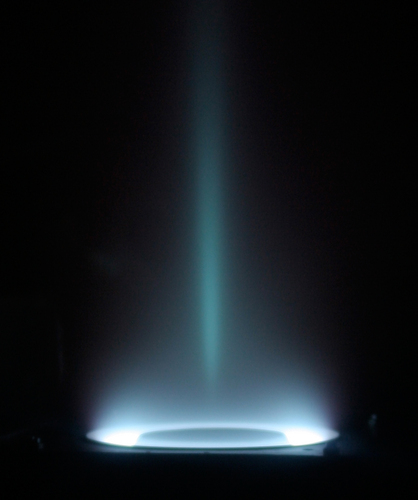
Princeton Art of Science Competition First Prize: Xenon Plasma Accelerator
When studying art and science, we typically look at the science of art, but let's flip things around a little, and look into the art of science.

The Princeton University 2010 Art of Science Competition is about finding art in original scientific research. Check out these ingenious works of art at the Art of Science 2010 Gallery. Here is a description of the exhibition from the website:
The 45 works chosen for the 2010 Art of Science exhibition represent this year’s theme of “energy” which we interpret in the broadest sense. These extraordinary images are not art for art’s sake. Rather, they were produced during the course of scientific research. Entries were chosen for their aesthetic excellence as well as scientific or technical interest.
I'd like to share an anecdote of my own, on a somewhat related relationship between art and science. A chemistry professor of mine, during our study of those colorful transition metals, loved to remark, "inorganic chemistry is intrinsically beautiful." He would lay out various transition metals in weighing vials for us to see, bright vivid blues, reds, greens, etc--very beautiful indeed. And then, instead of simply saying, "Today, we are learning about transition metals", he would ask us, "Why are transition metals so beautifully colored?" And by answering that question (which is much more difficult to answer than first meets the eye!), we discovered how transition metals worked--the transitions of energy involved, the orbital interactions, etc. (Perhaps an artistic rendering of transition metals would have been a good candidate for the 2010 Art of Science Competition's theme of "energy".) So, through our exploration of the aesthetics of transition metals, we developed a scientific understanding as well. Indeed, science itself is, as my chemistry professor would say, "intrinsically beautiful."