Search the Synapse

Friday, December 20, 2013

Hello again! (Seeing in the Dark)

It's good to see you again (in the dark), and sorry for the hiatus. My school changed google platforms and this google account was no longer very accessible, so I started a new blog. Now that I'm out of school, I think it's high time to transfer blog posts, and say hello again. Hello! Stay tuned for a plethora of transferred posts, starting below with Radiolab, of course!

Radiolab Podcast: Seeing in the Dark
"While John finds truth in darkness, Zoltan sees an emotional void. And as they argue, they reveal some very powerful truths about how we connect to one another."

How do we connect to each other? In different ways, and that makes us richer. Take a listen (20 min or so), this is beautiful. 

Monday, September 24, 2012

Escher, Chopin, and String Theory

A reflection on "String Theory and Little Bangs" with Prof. Gubser
In a dinner discussion with the Princeton society, "Music in Mind," Princeton Physics professor, Steven Gubser, shared with a group of around 45 students his research in using string theory to describe collisions of heavy ions. Along the way, he made some creative relations to art and music. I'd like to share them here:

1) The vibrational modes of a superstring are like the overtones of a piano string, allowing blends of overtones to create a note. One difference, however, is that the vibrational modes of a superstring are much less constrained than the possible overtones of a piano string's. 

2) Professor Gubser explains how a hyperbolic geometry, AdS5, describes the geometry of D3-branes in a similar manner as an Escher artwork, "Angels and Demons:"


In Escher's artwork, the big angels are the same shape as the little angels, making the elements conformal.  It is a self within a self. For example, the large angels and small angels may be distorted from each other, but in the end, they are still angels. The theory of real-world gluons and quarks is likewise approximately conformal.

3) Finally, in the Q and A session, Professor Gubser left us with a general statement about a similar type of thinking within musicians and physicists. That is, namely, how to reconcile conflicting or seemingly opposing items into a fluid whole. He gives the example of Chopin, who smoothly meshed a 3 against 4 right hand vs left hand rhythm in his famous "Fantasie-Impromptu:" 

Lisewise, Professor Gubser argues that string theorists consistently must reconcile experimental data with theory, to see how the two could become consistent even in the face of seemingly inconsistent data.

Talk Description:
"String theory and little bangs"with Professor Steven Gubser, Princeton Physics departmenton Monday, September 24, 6-7 pm at the Mathey Firestone Society Room 
String theory is an attempt to describe all of fundamental physics starting from microscopic, vibrating strings.  In recent years there have been some remarkable successes in using stringtheory to describe collisions of heavy ions, which recreate the conditions present in the universe about a microsecond after the big bang.  I'll summarize these developments, introducing some of the personalities involved and using analogies to music and art where I can. String theory has been called the "theory of everything." It seeks to describe all the fundamental forces of nature. It encompasses gravity and quantum mechanics in one unifying theory. But it is unproven and fraught with controversy. 
Professor Steven Gubser is professor of physics at Princeton University (you may know him as your PHY 102 professor). His research focuses on theoretical particle physics, especially string theory, and the AdS/CFT correspondence. He is a widely cited scholar in these and other related areas. He is the author of "The Little Book of String Theory," which offers a short, accessible, and entertaining introduction to one of the most talked-about areas of physics today.   
Webpages: http://www.princeton.edu/physics/people/display_person.xml?netid=ssgubser&display=faculty, http://wwwphy.princeton.edu/~ssgubser/

Friday, July 20, 2012

Artistic Synthesis and Synthetic Art

There’s hardly a thing that a man can name
Of use or beauty in life’s small game
But you can extract in alembic or jar
From the "physical basis" of black coal-tar-
Oil and ointment, and wax and wine,
And the lovely colors called aniline;
You can make anything from a salve to a star,
If you only know how, from black coal-tar.

-Punch

For the creators out there--artists and musicians, scientists, humanists, engineers, I recommend this article: In Praise of Synthesis by Roald Hoffman.

As you open the article and start to groan because you see esoteric chemical molecules, hang in there and keep reading, and you'll find the hallmarks that link scientists and artists, similar things that President Shirley Tilghman mentioned in her Art of Science talk. Roald Hoffman was a recipient of the 1981 Nobel Prize in Chemistry, and these are his words:

Chemical synthesis not only shares some of the aesthetic criteria of art; I think it is art. At the same time, it is logic. 
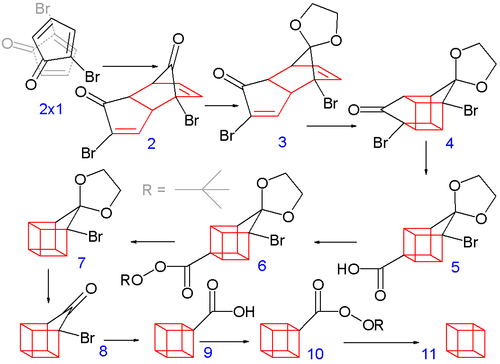
Consider the kind of art and creation that happens in making cubane:

The details of how it happens may be enigmatic, but surely it is obvious that a great process--part by design, part by chance, planned and experimented--occurs to create a elegant product. I agree, this is art. This is also logic. Wherein logic is art in this case, I also think, and I'm sure Escher would agree, that art is logic. Witness a Escher tessellation:

The mix of planning, experimentation, part by chance and part by design aspects of chemical synthesis are no doubt manifested in this beautiful, clever work of art--as in the beautiful, clever synthesis of cubane.

Beautiful logic (I mean art), isn't it?

Wednesday, July 11, 2012

Giving At-Risk Youth Genuine Voices through Music


Yesterday was my first day working for Genuine Voices. These youth are teenage boys incarcerated in detention centers for crimes ranging from misdemeanor to serious violations. The boys may have been neglected as children, with parents unable to take care of them or in prison. At the juvenile detention centers, they are learning how to control their aggression.
They four boys took turns choosing an instrument on Garageband and creating 8-count sections of music. A.D. (names altered for privacy) started with the strings solo and wanted to be the lead singer. Later, he asked me to send him the music file so he could practice. T.X. added drums. J.S. added piano. Finally, T.R. finished off with guitar, and was eager to be the recording producer and edit the music. Later, T.R. went to the drumset in the room, and started playing. He told me he would practice the drums whenever he had nothing to do.
I saw determination in them--their eagerness to create something meaningful to share with the world. When I mentioned we could share their songs and stories with the world--on Youtube or produce a CD, they became even more determined. I witnessed the power of music to bring out creativity, determination, and meaning into their lives. I believe in music intervention programs to give genuine voices to these boys' lives and help them become productive members of society. I am asking you to join me in support of enriching lives through music by donating to Genuine Voices.
Please support the boys and the community!
Your support will help Genuine Voices grow and contribute to affecting positive changes in the lives of at-risk youth such as A.D., T.X., J.S., and T.R, and the community. Your tax-deductible contribution supports the power of music to empower, inspire, and enrich lives. 100% of your donation goes toward Genuine Voices.
To donate, click here: http://www.gofundme.com/unl5s. Thank you for your support!
About Genuine Voices:
Genuine Voices is a non-profit organization that teaches music, musical composition, and computer-based music “sequencing” to youths in juvenile detention centers and other educational and institutional settings across the United States and Worldwide.
We believe that by fostering their musical abilities and skills we can assist youths in their ability to make positive life decisions.
Our program aims to provide youth with the experience of planning and creating finished music productions. We also wish to help juveniles discover the world through participation in cultural events, travel and by inviting musicians to perform.
Please visit www.genuinevoices.com for more information.
Below is a song created by an at-risk youth, recorded during a Genuine Voices session.