Search the Synapse

Saturday, December 18, 2010

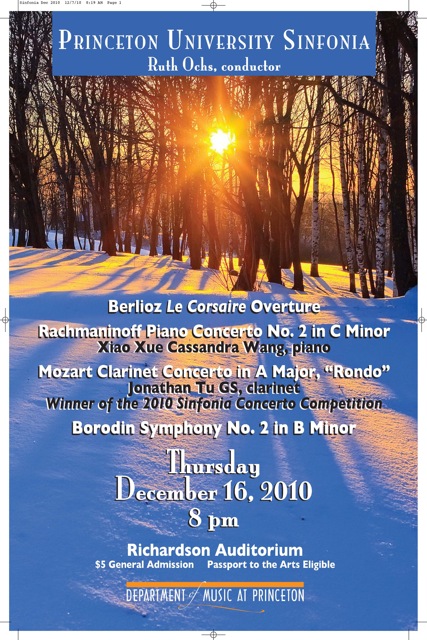
Sinfonia Concert: A Review

The Princeton University Sinfonia gave a fun-spirited concert on December 16 at Richardson Auditorium, with Ruth Ochs as conductor. The program consisted of  Berlioz’s Le Corsair Overture, Rachmaninoff’s Piano Concerto No. 2 (Cassandra Wang, piano), Rondo from Mozart’s Clarinet Concerto in A Major (Jonathan Tu, clarinet), and Borodin’s Symphony No. 2.

Berlioz’s Le Corsair Overture served as a riveting, bombastic opening to the concert, with Berlioz’s typical “come to the greatest show on earth” feel. Berlioz wrote the original version of this overture in August 1844 at Nice and led its first performance in Paris on January 19, 1845, then called La Tour de Nice (The Tower of Nice). Although the orchestra started off a little shaky, with entrances that could have been more confident, things eventually came together as the melody unfolded in the first section. Finally, the booms of the tympani resonating throughout the hall and the blaring brass served as a grandiose end to the beginning of a lively concert.

From such bombastic show of display, we are brought into another type of display: subtle virtuosity in Rachmaninoff’s famous Piano Concerto No. 2, composed in 1900-1901 and premiered with Rachmaninov himself as the soloist on November 9, 1901, in Moscow. I emphasize “subtle” virtuosity despite the obvious technical difficulty of the piece as a compliment to Cassandra Wang, the pianist. Cassandra glides through the runs with seeming effortlessness, and makes the most difficult of passages seem easy. Her playing reminds me of that of Yefin Bronfman’s, with a stoic body concealing the most expressive sounds. Her tone is warm and lyrical, taking the listener sighing into a far away dreamscape, especially in the beautiful adagio sostenuto. Cassandra deserves special commendation for her discerning ability to stay with the orchestra. The orchestra took the piece overall much slower than it is normally played, especially in Mvt. I and III, yet Xiao was able to restrain herself from the urge to rush (although noticeable) extremely well and patiently.  Although being greatly under tempo, and intonation issues in soloists (oboe), Cassandra’s solid and expressive performance made this piece the highlight of the concert.

Leaving behind the brilliant Romanticism of Rachmaninoff and the piano, we are transported to the wonderfully Classical world of Mozart and the clarinet in the Rondo from Mozart’s Clarinet Concerto in A Major. Mozart famous and only concerto for clarinet, known for its delicate interplay between orchestra and soloist, was written in 1791 for the clarinetist Anton Stadler. The clarinetist of the Sinfonia concert was Jonathan Tu, a graduate student at Princeton University and winner of the 2010 Sinfonia Concerto Competition. Despite a beautiful and warm tone, Jonathon had some trouble with his embouchure and excess air was often heard as he played. Nevertheless, the piece was quite enjoyable, maybe even a little too pleasant. In a way, the Mozart sounded a little too “perfect,” too “nice.” What was lacking in this performance, in both the orchestra and the soloist, was the feel of Mozartian whimsicality and playfulness. The dynamics were a little flat, and more contrasts would have made the experience more “fun,” in the playful Mozart style.

Finally, the concert ended with the heroic Borodin Symphony No. 2. The symphony was composed intermittently between 1869 and 1876, and is considered the most important large-scale work completed by the composer himself. Again, unconfident entrances took away from the boldness of the piece, especially in the opening sectional entrances of the Allegro theme. However, as the piece progressed, some really nice sounds started to come together. The double-tonguing of the brass in the Scherzo was effective in creating a underlying current of arousal, the vibratos of the strings created a wonderfully evanescent sound effect in the Andante, and the strong brassy sound at the end Finale served as a bold conclusion of finality. Sinfonia performed a concert of many popular delights in a more casual atmosphere. Though not a world-class orchestra, or the PUO, Sinfonia transports us to various places of musical adventure in a less intense manner.

Sunday, November 21, 2010

Music and Mental Illness: Buttonwood by Greg Spears

Tonight, the JACK Quartet gave a stunning world-premiere performance of Buttonwood by Greg Spears at the Crane Arts center in Philadelphia. It was a piece of beauty musically, conceptually, and contextually. Beauty undefined in all its abstraction.

Contextually, the piece reflects Greg’s experience as an artist-in-residence at the Buttonwood Psychiatric Hospital in the winter of 2010. During intermission, I talked with Dr. Schimmel and other hospital workers, who described Greg’s interaction with and dedication to the patients as going beyond anything expected. He would attend 3 hour meetings with hospital workers and patients, and trudge through coldness and snow to get there. He not only composed and performed for patients, but played with them. According to Dr. Schimmel, Buttonwood “captures the treatment team’s enthusiasm and narrative through various disciplines…the cacophony, feelings, and moods of the patients.” Conceptually, Greg describes the piece as portraying the “sense of external normalcy versus the intense drone of internal struggle” in the narratives of the patients. It is a beautiful concept—of leaving an imprint of such an experience for the composer, the patients, and the world, each able to take away what each will, with the hope that music can better the understanding of psychiatric illness.

Musically, the piece is one of profound beauty (if you’re willing to take my word for it). There is beauty in deviation. The violin reaches out in fragments of desperate abrupt crescendos against the drone of the cello. We feel the intense internal struggle of individual patients, of the desperate attempt to break the entrapment of illness (the violin’s cries) grounded by a sense of external continuity found in the hospital (the cello’s drone). Even in seeming normalcy, elements of deviation are detected by the listening ear. For example, there are times when two violins play the same melody the same time, but one is “normal,” the other is “dirty”, with scratches and screechings, signaling that while in life appears to continue in all its external regularity, inside things are on the verge of breaking apart. The piece begins and ends with a sense of peace and calmness, surprising given the context of psychiatric struggle and cacophony. Yet, beneath the calmness is a quiet loneliness, found in the quiet high-pitched cry of a violin. We leave with this sense of quiet loneliness steeped in an understanding of intense internal struggle—deep, profound, and beautiful.  

Yet, perhaps even more touching, even more beautiful than the conception, performance, or composition was the reception of the piece. Person after person after person came to talk to Greg after the performance (received with standing ovation), and to hear the words of gratitude from those from the hospital, to see the smiles on their faces and the appreciative warmth in their eyes, speaks to impact of Buttonwood in capturing the "quiet drama" of mental illness that could not be expressed, or only too often misunderstood.  Buttonwood is a testament to hidden struggle of the mentally ill, and a testament to the power of music to express where words fail.

Saturday, October 16, 2010

Artscience: Creativity in the Post-Google Generation

The Literary Vesicle excitedly releases Artscience by David Edwards. David Edwards is the founder of Le Laboratoire, an artscience center in Paris. The book is all about the wonderful fused applications of art and science that create innovation, about the beauty of "artscience":

There may be aesthetic aims that require application or understanding of the scientific method...or there may be scientific aims that require application or understanding of the aesthetic method...Either way, the fused method that results, at once aesthetic and scientific--intuitive and deductive, sensual and analytical, comfortable with uncertainty and able to frame a problem, embracing nature in its complexity and able to simplify to nature in its essence--is what I call artscience (p. 6-7). 

Some examples of artscience include:
·         Johannes Kepler--scientific discoveries in astronomy by optimizing what he viewed as the harmony of celestial bodies with musical notes
·         Diana Dabby--music composition through chaos theory, Olin College
·         Julio Ottino—fluid mixing (art and chemistry), Northwestern University
·         Kay Kaufman Shelemay—music as medicine, music and memory, Music, Ritual, and Falasha History, Harvard faculty.
·         Don Ingber—cellular structure modeled off a Buckminister Fuller tensegrity structure, Yale undergrad, Harvard faculty. Ingber is now “an international spokesperson for architecture and design in nature and biology."

Really, all science should be appreciated artistically, and enhanced as a result. (Even in organic chemistry, there's beauty in the geometric designs of molecules!)

Edwards proposes a realization of artscience through a process termed “idea translation”. The process is outlined below:

1.      Develop idea/concept through serious interdisciplinary study.
2.      Test idea through experimentation that may involve personal experience.
3.      Translate idea within or reaching outside of research institutions.
4.      Realize idea by arriving at an awareness of artscience as a catalyst to research.

I'll leave with a statement that is a favorite among favorites. Edward’s proposal is much closer to truth than proposal, in my opinion.

What I would like to propose is that scientists who create in the arts have the chance to become better scientists as a consequence.

Tuesday, September 28, 2010

Richard Schechner: "Art is cognitive as well as passionate...

...and theory is passionate as well as cognitive."

Today I had the wonderful opportunity of meeting Richard Schechner, who could be termed as one of the founders of Performance Studies--the study of the everyday life of performance. In addition to the brilliance of who he is and what he's done (Professor of Performance Studies at the Tisch School of the Arts, New York University, editor of TDR: The Drama Review, and artistic director of East Coast Artists, one of the founders of the Performance Studies department of the Tisch School of the Arts, New York University (NYU), the list goes on and on...), I'm inspired by his philosophy on life, and on the path to knowledge and ultimately wisdom.

Through the eyes of Schechner, knowledge is seeing things together, as in seeing wild imagination in the hard sciences (string theory, gluons?) and concrete theory in art. I see this as creativity as well, through the lens of Rosenthal, who describes the creative "janusian" process as seeing two distinct areas of space into one. I admire Schechner's passion behind idea, for he is "passionate about scholarship as if passionate about art," and makes a great statement again those critics of neuroaesthetics arguing that the statement "I don't want to study the science of art because I don't want to ruin art" is NOT TRUE. Schechner tackles a problem by pursuing a problem to the end, and seeing connections (and we can see he is very successful!)

Schechner comes up with many clever axioms, some of which I’d like to share (roughly quoted):
“Ignorance (of anything) to infinity is constant.”
“Improvisation must have structure. Structure must have improvisation.”
“Art is constantly as restatement, manipulation…”
“Serendipity is important.”

Here’s to another “artscientist,” as Daniel Edwards, author of Artscience, would say. And here’s to the artscientist within us all!